Base changing properties of Logarithms (Part 3) Lecture 7 logab = logcb/logca = 1/logba YouTube

Proofs of the logarithm properties: A(log B) = log (B^A) and log A - log B = log (A/B)Watch the next lesson: https://www.khanacademy.org/math/algebra2/logari.
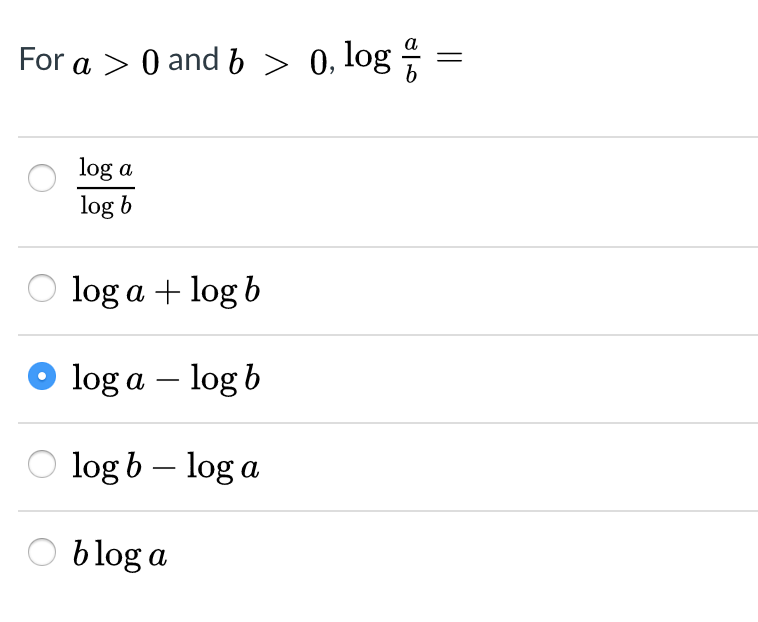
Solved = For a 〉 0 and b 〉 0, log log a log b log a + log b
4.95 (149) Cosy Apartment in a Heritage Building. 19th century heritage building. Beautifully furnished and bright private apartment for 1-2 pers. Situated in a quiet side street in prime location with view over the roofs of Munich and a chestnut tree. 2 minutes walk to the subway and bus station (U-Bhf. Schwanthalerhöhe).
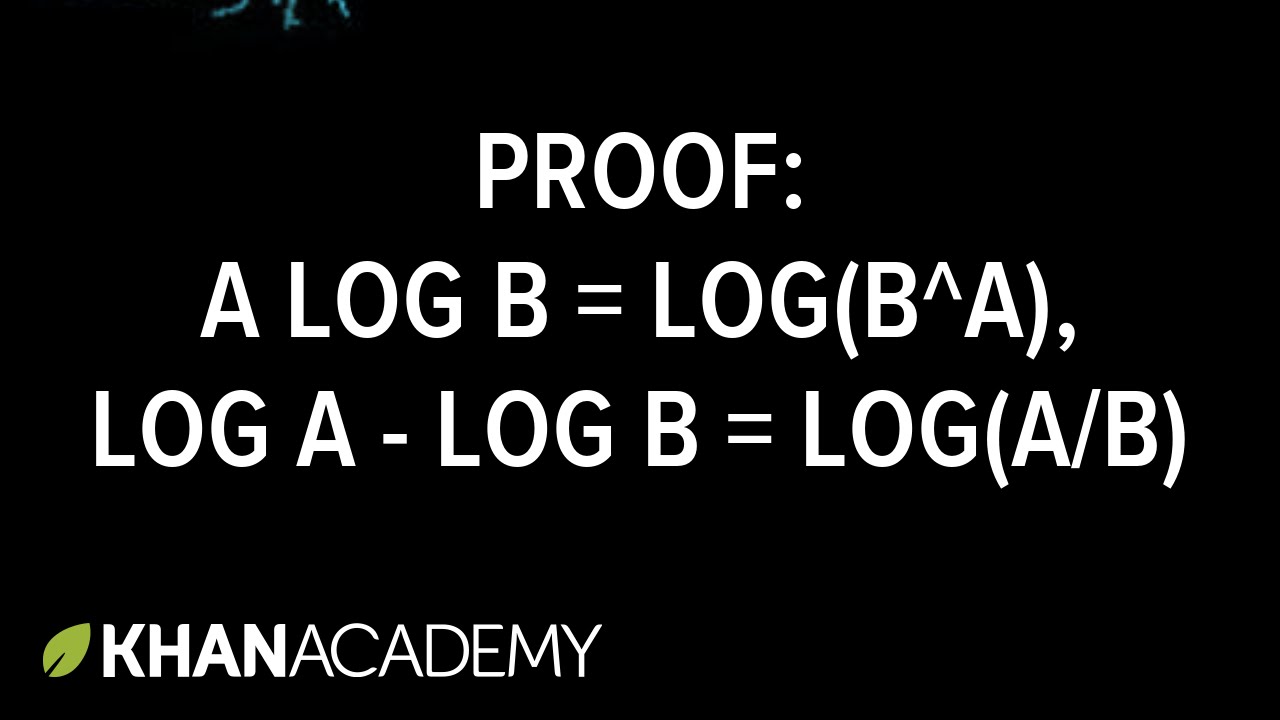
Proof a log b = log(b^a), log a log b = log(a/b) Logarithms Algebra II Khan Academy
Logarithm base change rule. The base b logarithm of x is base c logarithm of x divided by the base c logarithm of b. log b ( x) = log c ( x) / log c ( b) For example, in order to calculate log 2 (8) in calculator, we need to change the base to 10: log 2 (8) = log 10 (8) / log 10 (2) See: log base change rule.
Prove logAlogB=log(A/B) YouTube

The logarithm rules are the same for both natural and common logarithms (log, log a, and ln). The base of the log just carries to every log while applying the rules. log a 1 = 0 for any base 'a'. The most commonly logarithm rules are: log b mn = log b m + log b n. log b m/n = log b m - log b n. log b m n = n log b m.
Logarithmic Addition Identity,Logarithmic Identities Part 4, log a base b+log c base b=log(ac

of the product of A and B, that is logAB. For example, we can write log 10 5+log 10 4 = log 10 (5× 4) = log 10 20 The same base, in this case 10, is used throughout the calculation. You should verify this by evaluating both sides separately on your calculator. SecondLaw logA−logB = log A B So, subtracting logB from logA results in log A B.
Log a Base b Times Log b Base c Logarithm Multiplication Formula Logarithmic Identities

The answer would be 4 . This is expressed by the logarithmic equation log 2. . ( 16) = 4 , read as "log base two of sixteen is four". 2 4 = 16 log 2. . ( 16) = 4. Both equations describe the same relationship between the numbers 2 , 4 , and 16 , where 2 is the base and 4 is the exponent. The difference is that while the exponential form.
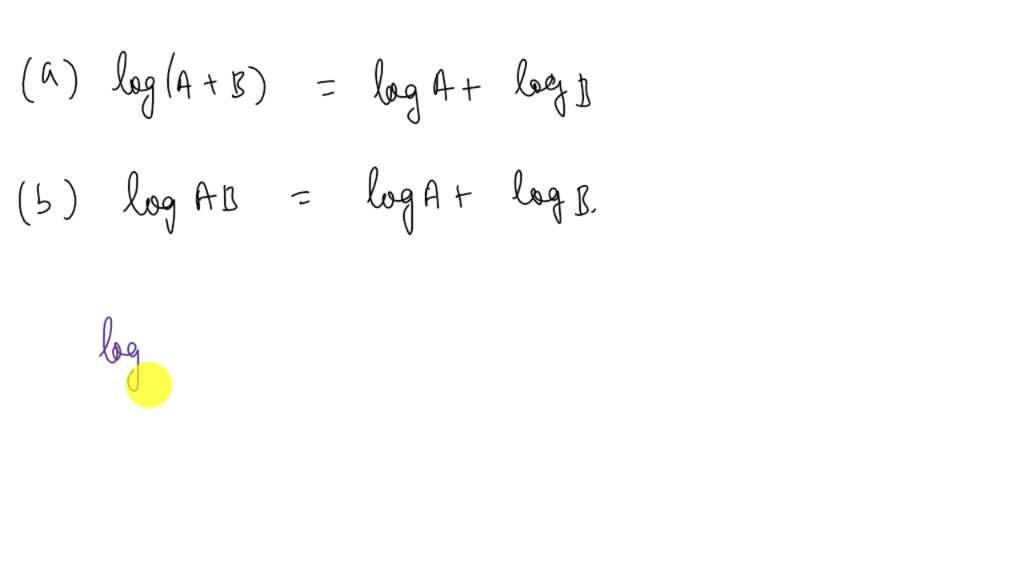
SOLVEDTrue or False? (a) log(A+B) is the same as logA+logB (b) logA B is the same as logA+logB
Rules of Logarithms. Descriptions of Logarithm Rules. Rule 1: Product Rule. The logarithm of the product is the sum of the logarithms of the factors. Rule 2: Quotient Rule. The logarithm of the ratio of two quantities is the logarithm of the numerator minus the logarithm of the denominator. Rule 3: Power Rule.
How to Prove the log a + log b = log ab logarithm property « Math
The product rule: log b( M N) = log b( M) + log b( N) This property says that the logarithm of a product is the sum of the logs of its factors. Show me a numerical example of this property please. M = 4 N = 8 b = 2 log 2. .
Prove the following identities logb a.logc b.logd c = logd a.

Official website of the German Football Record Champion FC Bayern Munich Tickets, News, Store & more Discover the world of FCB now!
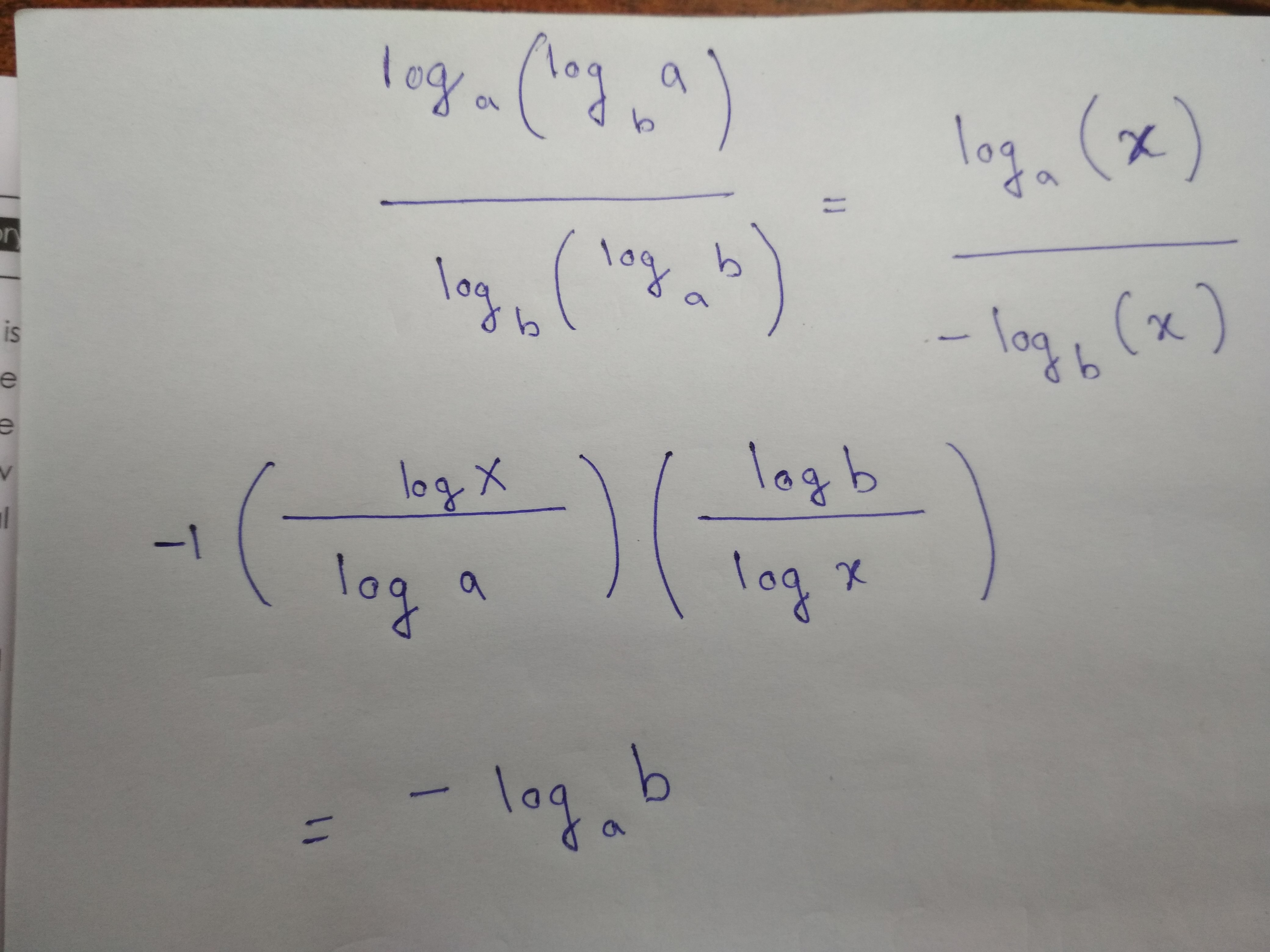
The value of `("log"_(a)("log"_(b)a))/("log"_(b)("log"_(a)b))`, is YouTube

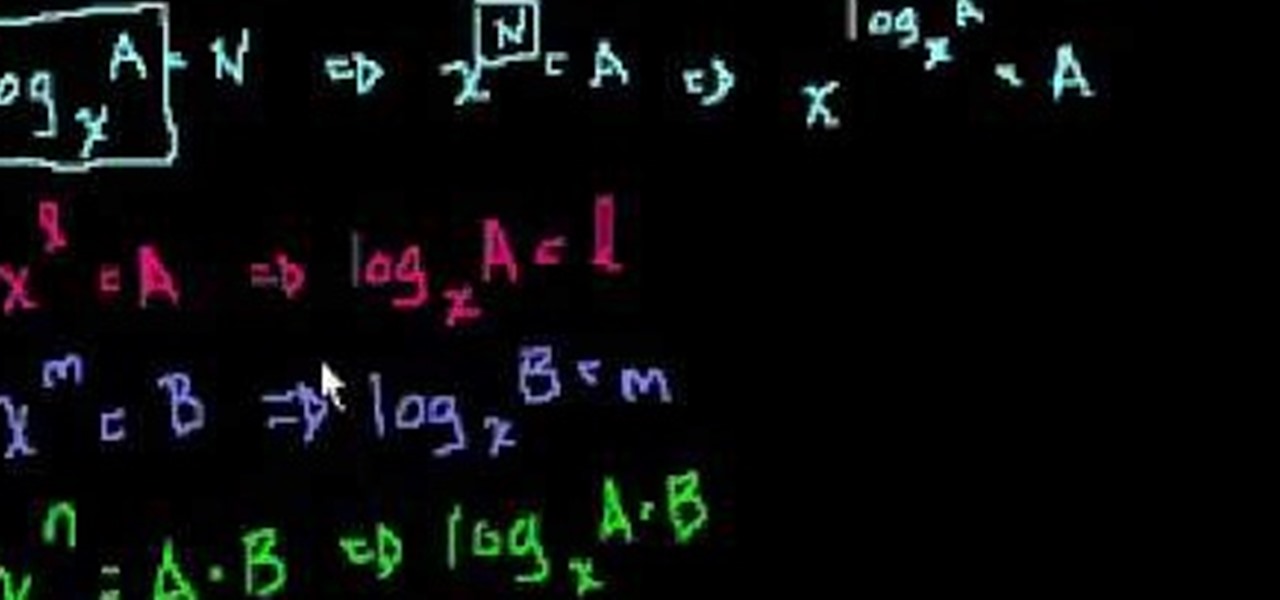
The product rule for logarithms states that log_x (A) + log_x (B) = log_x (A * B). Suppose we have the expressions: (LogX (A) = l) and (LogX (B) = m). According to the product rule, combining these two expressions should give us: log_x (A) + log_x (B) = log_x (A * B). However, we cannot directly add the two logarithmic expressions (log_x (A.
log(a*b) = log(a) + log(b) LogarithmusRegel erklärt und bewiesen YouTube

Proofs of Logarithm Properties or Rules. The logarithm properties or rules are derived using the laws of exponents.That's the reason why we are going to use the exponent rules to prove the logarithm properties below.
BasicLogarithmFormulas TRUNG TÂM GIA SƯ TÂM ĐỨC TÀI 091 62 65 673

b = a^M by the definition of the logarithm. Now take the natural logarithm (or other base if you want) of both sides of the equation to get the equivalent equation. ln (b)=ln (a^M). Now we can use the exponent property of logarithms we proved above to write. ln (b)=M*ln (a). Divide both sides by ln (a) to get.
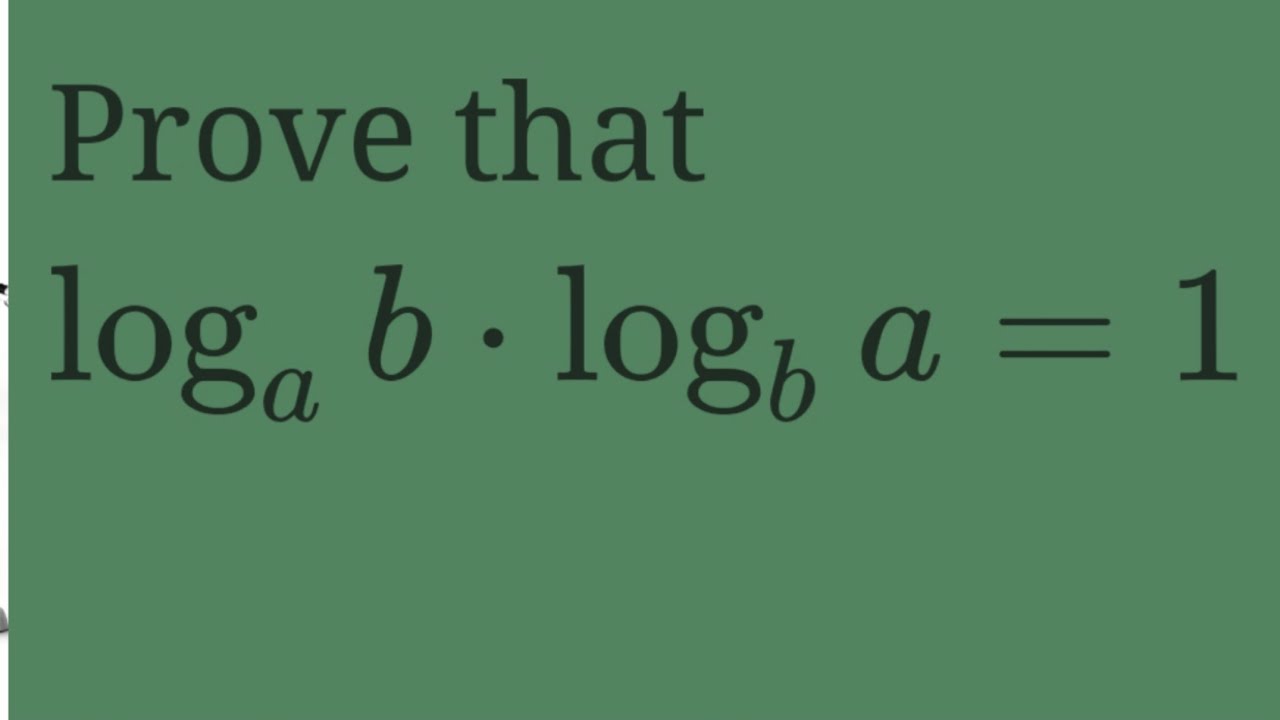
Prove that loga(b)*logb(a)=1 YouTube
Harassment is any behavior intended to disturb or upset a person or group of people. Threats include any threat of suicide, violence, or harm to another.
Why does log(ab)=log(a)+log(b)? YouTube

so we need to show that this holds for the right-hand side as well: alog(b)/ log(a) = (10log(a))log(b)/ log(a) =10log(a)⋅log(b)/ log(a) = 10log(b) = b. Since a raised to one of them is the same as a raised to the other one, they must be equal. This is all the time assuming that a, b > 0, a ≠ 1. Share. Cite. answered Apr 19, 2015 at 11:37.
Bevis for logaritmeregneregel log(a/b)=log(a)log(b) YouTube

Log b x = n or b n = x. Where b is the base of the logarithmic function. This can be read as "Logarithm of x to the base b is equal to n". In this article, we are going to learn the definition of logarithms, two types of logarithms such as common logarithm and natural logarithm, and different properties of logarithms with many solved.
Log a log b a/log b log a b = log ab send the solution of this probl askIITians
Example: log 4 (1) = 0 Identity Rule of Log. According to the identity rule, the logarithm of a base to itself is always 1. Formula: log a (a) = 1 Example: log 7 (7) = 1 Reciprocal Rule. According to the reciprocal rule of logarithms, the logarithm of a number's reciprocal (1 divided by that number) is equal to the negative of the logarithm of the original number.